Who can buy land to farm since the 2025 Bhu Kanoon, the lawful routes, and what to check on the ground.
Who this guide is for
You want land to farm, plant an orchard or keep animals on - or a farmhouse with land around it - and you need to know first whether the law lets you buy it at all.
Families from Uttarakhand adding to the land they farm.
Buyers from other States who want an orchard or a small farm.
For farmland, who the law counts you as decides almost everything.
If you are not an outside buyer
You are a tenure holder recorded in Uttarakhand's revenue records (other than a special-category bhumidhar who bought as an outside buyer), own property here acquired on or before 12 September 2003, or are a family member of such a person. A domicile certificate or years of living here is not the test.
Yes. The outside-buyer bars do not apply to you, though FEMA still does for NRIs.
You can buy land to farm in any district. Section 154(1) sets a ceiling of 12.5 acres, counted with land your family already holds, so check the area with an advocate before a large purchase; and if you are an NRI or OCI card holder, FEMA still bars buying agricultural land. Expect the Sub-Registrar to ask for proof of why you are not an outside buyer: the Khatauni recording you as a tenure holder, or a registered deed or other title document for property acquired on or before 12 September 2003, and proof of the family relationship if you rely on a relative. The rest of the law still applies: a farmhouse or other building on land recorded as agricultural needs a Section 143 declaration first, and land near a national park can fall in an eco-sensitive zone.
If you are an outside buyer
Anyone the Section 154 test does not cover - people from other States, and people who live in Uttarakhand but own no land here and no property acquired here on or before 12 September 2003.
Not in 11 of 13 districts. In Haridwar and Udham Singh Nagar, only with prior State sanction and a use affidavit.
Since 1 May 2025 an outside buyer cannot buy land for agriculture or horticulture in Dehradun, Nainital, Almora, Pauri Garhwal, Tehri Garhwal, Uttarkashi, Chamoli, Rudraprayag, Bageshwar, Pithoragarh or Champawat. In Haridwar and Udham Singh Nagar it needs prior State Government sanction and an affidavit that the land will be used only for agriculture, horticulture or connected uses; if the use changes, the transfer is void and the land can vest in the State. The 250 sq m route is for a home, not a farm. The lawful alternative is a lease: under Section 156 a landholder can lease land for up to 30 years for listed purposes such as agriculture, horticulture, dairy or alternative energy. The lease is entered in the remarks column of the Khatauni and does not make you the owner.
If you are an NRI or OCI card holder
Two sets of rules apply: India's foreign-exchange rules (FEMA), and the State land law, which treats you like any other outside buyer unless you meet the Section 154 test.
No: FEMA bars agricultural land, plantations and farmhouses. Inheriting is allowed.
Under India's foreign-exchange rules, NRIs and OCI card holders cannot buy agricultural land, plantation property or a farmhouse anywhere in India, whatever the State law says, though they can inherit them. Who inherits follows the succession rules that apply to that land, so check with an advocate how succession works for your land and what you can do with it afterwards. Confirm the FEMA position with a CA or advocate.
Where the land is changes the answer
Inside municipal limits
The 2025 amendment does not extend to land inside Nagar Nigam, Nagar Palika, Nagar Panchayat or Cantonment Board limits, but land brought within town limits after 7 July 1949 can still fall under the 1950 land law. Do not rely on a town boundary for a farm purchase without an advocate's view.
Outside municipal limits
In Dehradun, Nainital, Almora, Pauri Garhwal, Tehri Garhwal, Uttarkashi, Chamoli, Rudraprayag, Bageshwar, Pithoragarh and Champawat, buying land to farm or plant an orchard is closed to outside buyers.
Haridwar and Udham Singh Nagar
The only two districts where an outside buyer can still buy land to farm, with prior State Government sanction and a use affidavit. They are not exempt from the rest of the law: outside municipal limits the 250 sq m residential limit applies here too.
If a purchase breaks these rules
A transfer in breach of Section 154 is void, and the land is treated as vested in the State from the date of transfer, free of encumbrances, with no compensation to the buyer. The Act adds no money fine; recovering what you paid from the seller is a separate civil claim that can take years.
Whether you can buy it first, then the land itself.
Whether you can buy at all
Work out whether the Section 154 test covers you, and gather the proof before you pay any advance: the Khatauni recording you or your family member as a tenure holder, or a registered deed or other title document for property acquired on or before 12 September 2003, and proof of the relationship. Token money paid before you know whether you can buy does not protect you.
Check the land in the Khatauni on Bhulekh: every recorded co-owner, the area and the khasra numbers against the land you were shown, and what the record says the land is. The seller must be recorded as the owner of what is being sold.
Find out where irrigation water comes from - a canal, a village channel, a spring or a borewell - who else shares it, and how it holds up in summer. Rainfed terraces support different crops from irrigated land.
Soil, slope and terraces
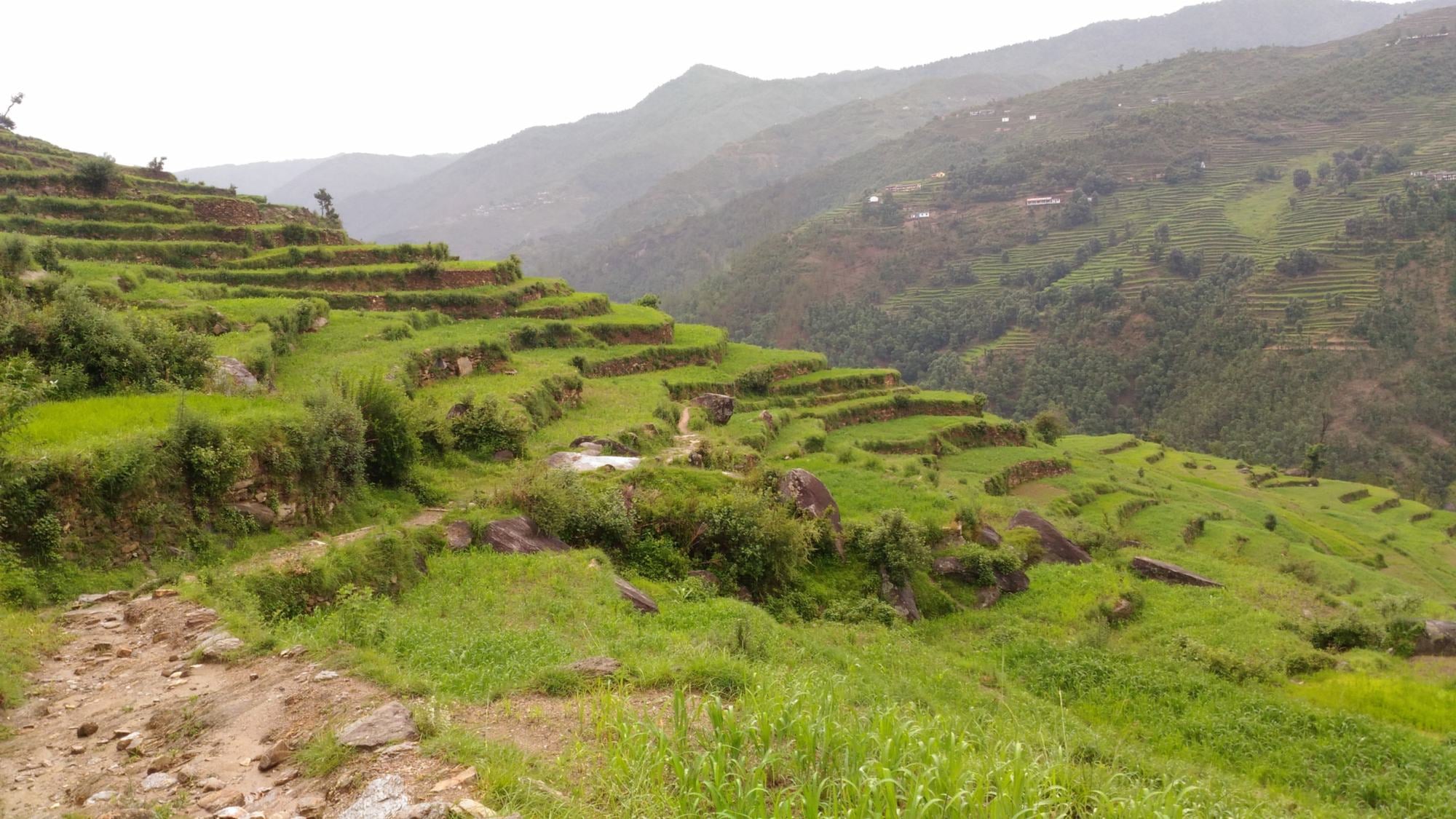
Walk the terraces: look for broken walls, slips and erosion, and how much of the area can really be cultivated. A soil test from a government soil-testing lab tells you what the land can grow before you plan an orchard.
Wild animals
Ask neighbouring farmers how much of their crop is lost to monkeys and wild boar, and what fencing they use. On some land it decides what is worth growing.
Access for tools and produce
Check how a tiller, a tractor or a pickup reaches the land, whether that path is a recorded right of way, and how far it is to a road you can use in the monsoon.
Co-owners and family shares
Hill land is often held jointly by several members of a family. Every recorded co-owner of the share being sold must sign, and the boundary of that share must be clear on the ground, not only on paper.
The use you promise
In Haridwar and Udham Singh Nagar an outside buyer gives an affidavit that the land will be used only for agriculture, horticulture or connected uses. If that use changes, the transfer is void and the land can vest in the State, so plan the farm you will actually run.
What sellers say about farmland
Each can be true of some land. Here is what it can hide, and what we check before you pay.
“Suitable for any purpose you want”
What you may do with land depends on its class and on who you are. A Section 143 declaration changes how land can be used, not who may buy it. If a purchase breaks the outside-buyer rules, the transfer can be declared void and the land can vest in the State.
What we check: Whether the law counts you as an outside buyer, and whether this land and this size of plot are open to you.
“Government lease land - as good as ownership”
A lessee holds land with the owner's permission, so that possession never turns into ownership, however long it lasts. Adverse possession needs open, continuous and hostile possession for 12 years against a private owner and 30 years against the Government (Limitation Act, Articles 65 and 112).
What we check: Whether the record shows freehold or a lease, and who granted the lease.
“Ready to build - no issues”
Land recorded as agricultural stays agricultural until a Section 143 declaration changes its use. And wherever a development authority covers the land, a building needs its map approved first.
What we check: What the record says the land is, any Section 143 order, and which authority a building would answer to.
“Clear title - no legal issues”
A sale deed shows one transfer, not the whole chain. A family claim, a missing heir or a pending case shows up in older records and court searches - which the seller does not have to show you.
What we check: Every khatauni entry back through the title chain, and court searches on the land and the sellers.
An advocate's title search and court searches, and the drafting and checking of the sale deed.
Survey and demarcation
Measuring the boundary against the revenue map and marking it on the ground, above all for a share of family land.
Water, terraces and fencing
Irrigation, repairing terrace walls, fencing against animals and improving the soil before the land produces.
Section 143, if you want to build
A farmhouse or other building on land recorded as agricultural needs a Section 143 declaration first. If you bought with a sanction and a use affidavit, take an advocate's advice before any change of use: a change can make the transfer void.
Not to farm or plant an orchard in 11 of the 13 districts: Dehradun, Nainital, Almora, Pauri Garhwal, Tehri Garhwal, Uttarkashi, Chamoli, Rudraprayag, Bageshwar, Pithoragarh and Champawat. In Haridwar and Udham Singh Nagar an outside buyer can buy land for agriculture or horticulture only with prior State Government sanction and an affidavit about its use. Whether you are an outside buyer depends on the Section 154 test, not on domicile.
A tenure holder recorded in Uttarakhand's revenue records (other than a special-category bhumidhar who bought as an outside buyer), the owner of immovable property in Uttarakhand acquired on or before 12 September 2003, or a family member of such a person: spouse, children (including step or adopted), parents, grandparents, brothers, and unmarried, widowed, separated or divorced sisters.
Yes, for listed purposes. Under Section 156, as amended in 2025, a landholder can lease land to any person, institution, society, trust, firm, company or self-help group for up to 30 years for agriculture, horticulture, herbs, off-season vegetables, medicinal and aromatic plants, spices, plantation, animal husbandry and dairy, poultry and livestock, beekeeping, fish farming, agro and food processing, tea, or alternative energy projects. The lease is entered in the remarks column of the Khatauni; it does not change who owns the land, and it does not cover a home or a resort.
No. FEMA does not let NRIs or OCI card holders buy agricultural land, plantation property or a farmhouse anywhere in India, though they can inherit it. Meeting the Section 154 test under the State law does not change the FEMA position. Confirm it with a CA or advocate.
Land recorded as agricultural stays agricultural until a Section 143 declaration changes its use, and a building needs its map approved wherever a development authority covers the land. If you bought land in Haridwar or Udham Singh Nagar with a sanction and an affidavit to use it only for agriculture, horticulture or connected uses, take an advocate's advice before any change of use: if the use changes, the transfer is void and the land can vest in the State.
The outside-buyer limits in Section 154 are written around sale and purchase, and Section 154A around acquisition by sale or gift. Inheritance is neither. Who inherits follows the succession rules that apply to that land, which for agricultural land can be the land law's own order of succession, and FEMA also lets NRIs and OCI card holders inherit agricultural land. Check with an advocate how succession works for your land and what you can do with it afterwards.
Sanctioned land must be used for the purpose it was sanctioned for. In Haridwar and Udham Singh Nagar the buyer gives an affidavit that the land will be used only for agriculture, horticulture or connected uses; if the use changes, the transfer is void and the land is treated as vested in the State, free of encumbrances and with no compensation.
Not for the land law. The Bhu Kanoon restrictions turn on whether you are a tenure holder in Uttarakhand, own property here acquired on or before 12 September 2003, or are a family member of such a person - not on a domicile or permanent-residence certificate.
Your details go to a seller or broker only when you ask us to, for example when you hire us to negotiate for you on a purchase from an individual owner (Complete Concierge).
Thorough checks
Records, courts, land rules and the ground - in writing.
Paid only by you
When we check a property for you, the seller pays us nothing.